Michele, I hope you never stop posting because you think you might not convince someone. I like your posts and on some occasions you made me change my point of view. On others they may not have changed my view but it stopped me long enough to consider my own reasoning. Besides there are others who might want to read a different view point.
You stated that “….there are a few differences regarding scientific conclusions and other logical conclusions”. First what he was referring to was that there was no difference in the reasoning used by scientist or others. This is an argument that has been written about on a number of occasions. There is no difference in the reasoning used by attorneys, police officers, tradesman, and businessmen with that of Scientist. This is a cornerstone argument against “The Scientific Method”. The difference in scientific conclusions and non-scientific conclusions is one is made by a Scientist and the other is not. Second we have syntax and learning differences. I never considered a difference between scientific and logical conclusions. My training stated that scientific conclusions are based upon logic. You can have good scientific (logical) conclusions or bad scientific (non-logical) conclusions. The difference is with the reasoning behind each, whether you have cogent (good) or fallacious (false) reasoning. Several months ago someone wrote something and used the term “Leap of Logic”. I have heard of “Leap of Faith” but never the first one. Poured over all my books on Logic, Reasoning and Philosophy and could not find that concept. Logic comes from reasoning. Reasoning is either good or bad. I was going to post something but then I thought like you in the beginning it would be just a feather in the wind.
I must apologize when I first read your post I thought you had stated that Huber and Ashbaugh described ACE-V as synonymous with the SM. Later when I read your post again I see that you only listed Huber. Having never read him, I do not have a way to rebut. Anyway before that, I pulled out my book by Ashbaugh and went to the index and there was nothing listed under Scientific Method. “Shucks” I said to myself. Now I am going to have to do a page by page review of his book. After 40 minutes I could not find any reference to the SM. On page 107 he mentions “Systematic and Analytical Methodology” which is right in line with my beliefs. He does mention in several places the “Scientific Process” and then on page 173 under Methodology he states “Scientific Procedure”. It could be argued that he means “The Scientific Method” when he says scientific process or scientific procedure, but I would argue that there are several different processes or procedures out there and which one did he mean. Only Mr. Ashbaugh could answer the question if he meant scientific process and procedure to by synonymous with “The Scientific Method”. I will have to say that in any of his descriptions of Analysis, Comparison or Evaluation he never mentioned the words “Hypothesis” or “Experimentation”, two key points to “The Scientific Method”. It seems to me that if Huber wrote ACE-V to be synonymous with the “The Scientific Method”, why did not Ashbaugh mention that in his book or go into Hypothesis or Experimentation during the Analysis, Comparison, or Evaluation stages. Of course later publications by Mr. Ashbaugh might have expanded on the ACE-V being the same as the Scientific Method. I know others have.
The following are more of my views on Science so you might understand where I am coming from. I believe there are a number of methods for Scientific Inquiry. They would come under the following groups: 1). Observation Models 2). Comparison Models 3). Experimental Models 4). Combination of all three. The Observation Models are those which are singular in purpose. Jane Goodall’s inquiry into the Great Apes would be an Observation Model. Comparison Models are geared towards 2 or more data sets. Dr. Leakey’s comparison of the bones of Lucy with other hominids is an example of a Comparison Model. The Scientific Method is normally associated with the Experimental Models due to its requirements of hypothesis and experimentation for validation. There are three approaches to inquiry, model, or method. A). Technical B). Analytical C). Scientific.
I consider ACE-V or the examination of friction ridge skin a Comparison Model with an Analytical approach. In short it is Comparative Analysis. In dealing with conclusions based upon Comparative Analysis there are six questions that should (must) be answered:
1. What conclusions are you making from your analysis?
2. What specific details support your conclusion?
3. What additional evidence supports your conclusion?
4. What underlying principals support your conclusion?
5. What disagreements might be raised about your conclusion?
6. In what ways should you qualify your conclusion?
My science classes in school dealt with Botany, Geology, Logic and Philosophy. All through high school and college I do not recall any mention of the “The Scientific Method”. That does not mean they did not mention it. I could have been recovering from a hang-over, or skipped class to shoot pool. My earliest recollection of “The Scientific Method” was at SWGFAST in about 1998. The way it was explained I thought it was fabulous in describing Latent Print Examinations. The more I tried to use it the more I realized it did not work for me. I went back to my roots and that is what I have listed above.
If it works for you then by all means use it. If you can explain it and not lose anyone, then use it. I did not cut my teeth on it and I have a problem with the Hypothesis and Experimentation parts.
As usual any comments are welcome. I will print them out and make a paper basketball out of them (just kiddin).
Charles Parker
At Home Sick
Latent Print Community
-
Charles Parker
- Posts: 586
- Joined: Mon Jul 04, 2005 6:15 am
- Location: Cedar Creek, TX
Response
Knuckle Draggin Country Cousin
Cedar Creek, TX
Cedar Creek, TX
-
Michele
- Posts: 384
- Joined: Tue Dec 06, 2005 10:40 am
Charles,
Exactly what science is and when it began is open to interpretation. Many people might say that it began somewhere around 1200ad-1600ad, but I think it started much earlier in a very simple form. I think it started back with Socrates around 400bc. Socrates thought that if you wanted to come to the best conclusion, this would be done by questioning things (instead of just listening to those with power and prestige). Aristotle added to this by suggesting testing and experimenting and Thales added that people should collect information and hypothesis about different possibilities. I think my idea that this was the beginning is supported by the fact that these are the main elements of Hypothesis Testing (which became known as the SM). Over the next 2000 years science evolved to be very complex, but I believe this is science in its simplest form. I believe this is what we’re doing in analyzing prints.
1. Question: does this latent print have value to compare to others?
2. Hypothesize: I’ll guess yes.
3. Test: collect information to prove or disprove the hypothesis.
4. Make a conclusion: lets just say we’ve concluded- it’s of value
5. Peer review-leave all your data and ideas open to others to review
6. Question: was the print left by Charles?
7. Hypothesize: I’ll guess yes.
8. Test: look for information to support or refute the hypothesis
9. Experiment or prediction: if I look 3 ridges up will I see a bifurcation (continue testing the hypothesis until you believe you’ve done enough to establish a valid conclusion)
10. May need to change the hypothesis and retest
11. May want to consult with others
12. Make a conclusion:
13. Peer review: leave all your data and ideas open to others to review
Unfortunately our profession still uses a tactic used in Socrates times…..if you don’t like the conclusion, just kill the person who arrived at this conclusion (we’ve lightened up a bit, now we just ban them from the profession).
The above example is very simple and we have premises, principles and other scientific tenets that we can also use, making it a little more complicated.
Since this is how I view a very simple form of science, I would say that the cornerstone argument against scientific deduction (that everyone uses this form of logic) isn’t an argument against science at all. To me, it looks like an argument that supports how reliable and valid this form of reasoning is. Using logical deduction (hypothesis testing or scientific method) works so well that everyone uses it to arrive at conclusions. As you can probably guess, from this view, a scientific analysis is an analytical analysis.
I think most people think of science as being complicated and if what you’re doing isn’t complicated it can’t be scientific. I disagree, science can be as simple or as complex as you choose to make it.
Personally I believe we have the same views but are just labeling it differently. The ‘just’ in the previous sentence could be a lot more important than implied. Labeling what we do as scientific or non-scientific artificially may tell a jury that the conclusion is either credible or non-credible. This entire topic could also be viewed by our critics as a lack of agreement on the basic ideas behind what we do.
Anyway, I think that if the industry (or even an individual agency) is going to say that what we do is a science then they should be able to back up this statement. While I was in training and I asked for the justification behind the claim (after a defense attorney asked me this question), I couldn’t find an answer that satisfied me (or an answer that I thought would satisfy an attorney). After years of reading, talking with other people, and asking lots of questions, this is how I now explain it. Personally, I think swgfast needs to articulate this for the practitioners of our field, but then again any complete explanation would probably end up being an entire book.
btw, I liked your basketball comment!
Exactly what science is and when it began is open to interpretation. Many people might say that it began somewhere around 1200ad-1600ad, but I think it started much earlier in a very simple form. I think it started back with Socrates around 400bc. Socrates thought that if you wanted to come to the best conclusion, this would be done by questioning things (instead of just listening to those with power and prestige). Aristotle added to this by suggesting testing and experimenting and Thales added that people should collect information and hypothesis about different possibilities. I think my idea that this was the beginning is supported by the fact that these are the main elements of Hypothesis Testing (which became known as the SM). Over the next 2000 years science evolved to be very complex, but I believe this is science in its simplest form. I believe this is what we’re doing in analyzing prints.
1. Question: does this latent print have value to compare to others?
2. Hypothesize: I’ll guess yes.
3. Test: collect information to prove or disprove the hypothesis.
4. Make a conclusion: lets just say we’ve concluded- it’s of value
5. Peer review-leave all your data and ideas open to others to review
6. Question: was the print left by Charles?
7. Hypothesize: I’ll guess yes.
8. Test: look for information to support or refute the hypothesis
9. Experiment or prediction: if I look 3 ridges up will I see a bifurcation (continue testing the hypothesis until you believe you’ve done enough to establish a valid conclusion)
10. May need to change the hypothesis and retest
11. May want to consult with others
12. Make a conclusion:
13. Peer review: leave all your data and ideas open to others to review
Unfortunately our profession still uses a tactic used in Socrates times…..if you don’t like the conclusion, just kill the person who arrived at this conclusion (we’ve lightened up a bit, now we just ban them from the profession).
The above example is very simple and we have premises, principles and other scientific tenets that we can also use, making it a little more complicated.
Since this is how I view a very simple form of science, I would say that the cornerstone argument against scientific deduction (that everyone uses this form of logic) isn’t an argument against science at all. To me, it looks like an argument that supports how reliable and valid this form of reasoning is. Using logical deduction (hypothesis testing or scientific method) works so well that everyone uses it to arrive at conclusions. As you can probably guess, from this view, a scientific analysis is an analytical analysis.
I think most people think of science as being complicated and if what you’re doing isn’t complicated it can’t be scientific. I disagree, science can be as simple or as complex as you choose to make it.
Personally I believe we have the same views but are just labeling it differently. The ‘just’ in the previous sentence could be a lot more important than implied. Labeling what we do as scientific or non-scientific artificially may tell a jury that the conclusion is either credible or non-credible. This entire topic could also be viewed by our critics as a lack of agreement on the basic ideas behind what we do.
Anyway, I think that if the industry (or even an individual agency) is going to say that what we do is a science then they should be able to back up this statement. While I was in training and I asked for the justification behind the claim (after a defense attorney asked me this question), I couldn’t find an answer that satisfied me (or an answer that I thought would satisfy an attorney). After years of reading, talking with other people, and asking lots of questions, this is how I now explain it. Personally, I think swgfast needs to articulate this for the practitioners of our field, but then again any complete explanation would probably end up being an entire book.
btw, I liked your basketball comment!
Michele
The best way to escape from a problem is to solve it. Alan Saporta
There is nothing so useless as doing efficiently that which should not be done at all. Peter Drucker
(Applies to a full A prior to C and blind verification)
The best way to escape from a problem is to solve it. Alan Saporta
There is nothing so useless as doing efficiently that which should not be done at all. Peter Drucker
(Applies to a full A prior to C and blind verification)
-
Strict Scrutiny
- Posts: 38
- Joined: Thu Aug 31, 2006 10:45 pm
John, Thank you for the reply. You have written some great things here. I cannot say that I disagree in essence with any of your message. Yet I offer a significantly different perspective, as is to be expected in a forum dedicated to open debate.
The beauty of ACE-V is that it demands us to put subjectivity in a cage and only let it out during evaluation. To allow subjective thought prior to that point is acceptable in other sciences, but too risky for our profession. It is up to each examiner to “walk the walk” because subjectivity and bias are very insidious things. Not so risky when we are musing about theory in a classroom, but quite dangerous if one does not understand that ACE-V is a structure (like a blueprint) to end up with more reliable results, and should be treated quite rigidly when the magnifier goes on the print.
Furthermore, I don’t believe pure science is happening on the bench in DNA analysis or Latent Print Examination. I think we should be careful about implying that is does:
I have to say that your insights into cognitive vision are fascinating. I look forward to reading more from you.
I think pure science is the quest for knowledge simply for the sake of knowledge, and applied science is the use of knowledge to solve a specific occupational task or problem. I believe pure science will feed applied science, but to be on task and focused we must acknowledge the difference between the two meanings of science, and use them differently. The biggest difference between the two (for this discussion) is that pure science will allow greater latitude for one to hypothesize because gaining knowledge is King, where science applied to the examination of fingerprints must be carefully honed for the practitioner, and narrowed to only allow subjectivity in at the correct moment.John Vanderkolk wrote:Please tell me what a 'pure science' is and if there are any errors, or potential errors within the rules of that 'pure science'. To me, 'pure' sounds like 'without error'.
The beauty of ACE-V is that it demands us to put subjectivity in a cage and only let it out during evaluation. To allow subjective thought prior to that point is acceptable in other sciences, but too risky for our profession. It is up to each examiner to “walk the walk” because subjectivity and bias are very insidious things. Not so risky when we are musing about theory in a classroom, but quite dangerous if one does not understand that ACE-V is a structure (like a blueprint) to end up with more reliable results, and should be treated quite rigidly when the magnifier goes on the print.
Furthermore, I don’t believe pure science is happening on the bench in DNA analysis or Latent Print Examination. I think we should be careful about implying that is does:
Hopefully pure science will be more of a force in our profession. We will no doubt rely on more research in the future to formulate our policies. But we must know how to harness pure science for maximum benefit, because if we are not focused we can also be victims of our own musings.Michele Triplett wrote: SM can be used for principles or for individual conclusions, at least that's how it's taught in the United States 6th grade sciences classes. This is also accepted by many scientific minded people (but I agree, it's not accepted by all of them).
About your definitions of a theory......one is a layman's definition and one is a scientific definition. They are both valid definitions but only apply in their respected areas.
About DNA analysts, as you describe their work, many would say this is a technical process and not a purely scientific process.
I have to say that your insights into cognitive vision are fascinating. I look forward to reading more from you.
-
Charles Parker
- Posts: 586
- Joined: Mon Jul 04, 2005 6:15 am
- Location: Cedar Creek, TX
Response
Michele, I think if you consider mathematics a science (some do, some don’t’) you could it extend it back to the Egyptians as they used fractions and had a system of questioning symptoms to identify and treat illness. Wikipedia has a good section on the history of science. John if you are reading this they have a good explanation of pure science and applied science.
Socrates had a method of questioning that was named after him, the Socratic Method (dialectic). It was basically answering a question with a question. One source (Wikipedia) states that it is a negative method of hypothesis elimination. No doubt Aristotle was very good but I could not find much on his testing and experimentation, but my search time was limited. The only thing I found on Thales was that he lived 150 years before Socrates (Pre-Socratic Philosophy). Wikipedia is a wealth of information. I spent most of the day on that site, mainly reading on science, scientific method, etc. Each section has like a chat room and I looked at over 200 entries on the scientific method alone. It confirmed my belief that “The Scientific Method” is used for investigation of phenomena and acquiring new knowledge and not for technical or analytical applications unless the purpose is to replace the existing models (new knowledge). Of course that is my interpretation and may not coincide with others.
I find your analysis model interesting. I will put together one of mine and send it to you. Then you can make a paper basketball.
I hope you are not serious about if someone does not like your ideas that you are banned. I may not agree with you or other people on some points but I will fight to the death your right to say your ideas (without fear of being ostracized). Socrates once said, “I know you won’t believe me, but the highest form of Human Excellence is to question oneself and others”.
I was not aware of an argument against deductive reasoning. I believe that deductive and inductive reasoning are very important in Science.
I agree that science is what you make it. People can make it complex or simple.
You may be right probably a syntax thing. However your following statement has me confused: “Labeling what we do as scientific or non-scientific artificially may tell a jury that the conclusion is either credible or non-credible. This entire topic could also be viewed by our critics as a lack of agreement on the basic ideas behind what we do”.
A few points on that statement:
1. It sounds to me like you are asking that one of us give up our beliefs so as not to confuse the juries and deny ammunition to our critics?
2. Are you stating that non-scientific conclusions are non-credible?
3. Are you stating that Science is the only way for credible conclusions?
A few points from me:
1. I never said what I did was not science. My whole crux was the concept of using “The Scientific Method” as the only means of explaining the comparison of friction ridge detail.
2. I do not see a great disparity in you going into court and stating that you have arrived at your conclusion using “The Scientific Method” and I going into a court and stating that I arrived at my conclusion through a method of Analysis consisting of evaluation, comparison, and conclusion with an independent review of the evidence.
3. Perhaps I misunderstood the paragraph?
In conclusion, I must have read 20 definitions of science today. A lot of our differences are our concept or definition of science. Mine is probably old-fashioned, but it makes sense to me. I do believe that if I heard something better I would adopt it. With SWGFAST they have a difficult chore. To get 35 people to agree in a majority vote what is science to the fingerprint discipline would be like Hannibal crossing the Alps, extremely difficult. It could be done but a lot of people are not going to like the final product.
Take care as I need to go to bed and then work tomorrow.
Socrates had a method of questioning that was named after him, the Socratic Method (dialectic). It was basically answering a question with a question. One source (Wikipedia) states that it is a negative method of hypothesis elimination. No doubt Aristotle was very good but I could not find much on his testing and experimentation, but my search time was limited. The only thing I found on Thales was that he lived 150 years before Socrates (Pre-Socratic Philosophy). Wikipedia is a wealth of information. I spent most of the day on that site, mainly reading on science, scientific method, etc. Each section has like a chat room and I looked at over 200 entries on the scientific method alone. It confirmed my belief that “The Scientific Method” is used for investigation of phenomena and acquiring new knowledge and not for technical or analytical applications unless the purpose is to replace the existing models (new knowledge). Of course that is my interpretation and may not coincide with others.
I find your analysis model interesting. I will put together one of mine and send it to you. Then you can make a paper basketball.
I hope you are not serious about if someone does not like your ideas that you are banned. I may not agree with you or other people on some points but I will fight to the death your right to say your ideas (without fear of being ostracized). Socrates once said, “I know you won’t believe me, but the highest form of Human Excellence is to question oneself and others”.
I was not aware of an argument against deductive reasoning. I believe that deductive and inductive reasoning are very important in Science.
I agree that science is what you make it. People can make it complex or simple.
You may be right probably a syntax thing. However your following statement has me confused: “Labeling what we do as scientific or non-scientific artificially may tell a jury that the conclusion is either credible or non-credible. This entire topic could also be viewed by our critics as a lack of agreement on the basic ideas behind what we do”.
A few points on that statement:
1. It sounds to me like you are asking that one of us give up our beliefs so as not to confuse the juries and deny ammunition to our critics?
2. Are you stating that non-scientific conclusions are non-credible?
3. Are you stating that Science is the only way for credible conclusions?
A few points from me:
1. I never said what I did was not science. My whole crux was the concept of using “The Scientific Method” as the only means of explaining the comparison of friction ridge detail.
2. I do not see a great disparity in you going into court and stating that you have arrived at your conclusion using “The Scientific Method” and I going into a court and stating that I arrived at my conclusion through a method of Analysis consisting of evaluation, comparison, and conclusion with an independent review of the evidence.
3. Perhaps I misunderstood the paragraph?
In conclusion, I must have read 20 definitions of science today. A lot of our differences are our concept or definition of science. Mine is probably old-fashioned, but it makes sense to me. I do believe that if I heard something better I would adopt it. With SWGFAST they have a difficult chore. To get 35 people to agree in a majority vote what is science to the fingerprint discipline would be like Hannibal crossing the Alps, extremely difficult. It could be done but a lot of people are not going to like the final product.
Take care as I need to go to bed and then work tomorrow.
Knuckle Draggin Country Cousin
Cedar Creek, TX
Cedar Creek, TX
-
Dogma
- Posts: 48
- Joined: Mon Dec 12, 2005 8:02 am
Well, I told myself I was going to let this drop, but I also thought I wasn't going to over eat on Thanksgiving and that didn't work out either, so:
BTW: the US Dept. of Education found that high school students in the United States are consistently outperformed by those from Asian and some European countries on international assessments of mathematics and science, according to The Condition of Education 2006 report. If only we had gotten to them in the 6th grade!
And certainly: “Have you any theory, Holmes?” (Watson to his friend in "The Adventure of Shoscombe Old Place.")
Dear Charles,
Of course mathematics is a science. Some consider it just a language used to express scientific principles. But where would Einstein or any theoretical physicist be without it? It could be said that chemistry is just a language that helps us express our understanding of the biological sciences (ATCG) or the elemental aspects of physics.
Mathematics is the study of quantifiable relationships. It not only enables us to describe "how much" but also concepts of when (time) and where (space).
My education went far beyond the 6th grade so I guess my view is more mature than some. I don't recall any of my physics or chemistry professors referring me back to what I learned in grammar school although I recall a popular book a few years ago which claimed that all we needed to know was learned in Kindergarten. I suppose they had also matured to that place where they can confidently challenge the habitual recitation of dogma and looked at things with a new and inquistive eye, sometimes challenging ideas put forward in their own lectures.SM can be used for principles or for individual conclusions, at least that's how it's taught in the United States 6th grade sciences classes. This is also accepted by many scientific minded people (but I agree, it's not accepted by all of them).
BTW: the US Dept. of Education found that high school students in the United States are consistently outperformed by those from Asian and some European countries on international assessments of mathematics and science, according to The Condition of Education 2006 report. If only we had gotten to them in the 6th grade!
I always remind myself that what we do professionaly isn't worth a hoot if we can't convince others of our findings. I tend to speak and write on these issues as though I was addressing a jury, better known in some circles as laymen. If you use the term "theory" to most people they think that you are speaking of an idea or premise that may or may not be valid but which falls short of having been proved. Just think of those religious fundamentalists who challenge evolution by stating, "It's only a theory!"About your definitions of a theory......one is a layman's definition and one is a scientific definition. They are both valid definitions but only apply in their respected areas.
And certainly: “Have you any theory, Holmes?” (Watson to his friend in "The Adventure of Shoscombe Old Place.")
See? We do agree on something. I addressed that very thing some time ago in another post for which the moderator took me to the wood shed. Most forensic examinations involve a technical process and not scientific investigation. The examiner does not offer an opinion about their findings. They just report testing results stating that the results fall within certain predetermined parameters. But, please don't tell them I said so. They are so proud of themselves.About DNA analysts, as you describe their work, many would say this is a technical process and not a purely scientific process.
Dear Charles,
Of course mathematics is a science. Some consider it just a language used to express scientific principles. But where would Einstein or any theoretical physicist be without it? It could be said that chemistry is just a language that helps us express our understanding of the biological sciences (ATCG) or the elemental aspects of physics.
Mathematics is the study of quantifiable relationships. It not only enables us to describe "how much" but also concepts of when (time) and where (space).
-
Charles Parker
- Posts: 586
- Joined: Mon Jul 04, 2005 6:15 am
- Location: Cedar Creek, TX
Dogma
Dogma, I agree that Mathamatics is a science. But I ran across the following information this weekend and I thought it was interesting.
Mathematics and the scientific method
Mathematics is essential to many sciences. The most important function of mathematics in science is the role it plays in the expression of scientific models. Observing and collecting measurements, as well as hypothesizing and predicting, often require mathematical models and extensive use of mathematics. Mathematical branches most often used in science include calculus and statistics, although virtually every branch of mathematics has applications, even "pure" areas such as number theory and topology. Mathematics is most prevalent in physics, but less so in chemistry, biology, and some social sciences.
Some thinkers see mathematicians as scientists, regarding physical experiments as inessential or mathematical proofs as equivalent to experiments. Others do not see mathematics as a science, since it does not require experimental test of its theories and hypotheses, although some theorems can be disproved by contradiction through finding exceptions. (More specifically, mathematical theorems and formulas are obtained by logical derivations which presume axiomatic systems, rather than a combination of empirical observation and method of reasoning that has come to be known as scientific method.) In either case, the fact that mathematics is such a useful tool in describing the universe is a central issue in the philosophy of mathematics.
Further information: Eugene Wigner, The Unreasonable Effectiveness of Mathematics in the Natural Sciences
Richard Feynman said "Mathematics is not real, but it feels real. Where is this place?"[verification needed], while Bertrand Russell quipped, in allusion to the abstraction inherent in the axiomatic method, that "Mathematics may be defined as the subject in which we never know what we are talking about, nor whether what we are saying is true."
Mathematics cannot be considered pure science as everything that is mathematically correct may not be physically or practically correct. It is a tool to study various fields of science and to effectively pursue the scientific method.
A different view point.
Mathematics and the scientific method
Mathematics is essential to many sciences. The most important function of mathematics in science is the role it plays in the expression of scientific models. Observing and collecting measurements, as well as hypothesizing and predicting, often require mathematical models and extensive use of mathematics. Mathematical branches most often used in science include calculus and statistics, although virtually every branch of mathematics has applications, even "pure" areas such as number theory and topology. Mathematics is most prevalent in physics, but less so in chemistry, biology, and some social sciences.
Some thinkers see mathematicians as scientists, regarding physical experiments as inessential or mathematical proofs as equivalent to experiments. Others do not see mathematics as a science, since it does not require experimental test of its theories and hypotheses, although some theorems can be disproved by contradiction through finding exceptions. (More specifically, mathematical theorems and formulas are obtained by logical derivations which presume axiomatic systems, rather than a combination of empirical observation and method of reasoning that has come to be known as scientific method.) In either case, the fact that mathematics is such a useful tool in describing the universe is a central issue in the philosophy of mathematics.
Further information: Eugene Wigner, The Unreasonable Effectiveness of Mathematics in the Natural Sciences
Richard Feynman said "Mathematics is not real, but it feels real. Where is this place?"[verification needed], while Bertrand Russell quipped, in allusion to the abstraction inherent in the axiomatic method, that "Mathematics may be defined as the subject in which we never know what we are talking about, nor whether what we are saying is true."
Mathematics cannot be considered pure science as everything that is mathematically correct may not be physically or practically correct. It is a tool to study various fields of science and to effectively pursue the scientific method.
A different view point.
Knuckle Draggin Country Cousin
Cedar Creek, TX
Cedar Creek, TX
-
John Vanderkolk
- Posts: 73
- Joined: Tue Feb 28, 2006 7:07 am
- Location: Washington, DC
Charles wrote:
For the relations of mathematics to pattern and form I will share a small sample of what he wrote on pages 10 and 11:
"The natural language of pattern and form is mathematics. This may dismay those of you who never quite made friends with this universal tool of science, and it may seem a little disappointing too - for patterns and forms can be things of tremendous beauty, whereas mathematics can often appear to be a cold, unromantic and, well, calculated practice. But mathematics has its own very profound beauty too, and this is something that you do not any longer have to take on trust. The now familiar images of fractal forms and patterns demonstrate that mathematics is perfectly able to produce and describe structures of immense complexity and subtlety.
The main point is that mathematics enables us to get to grips with the essence of pattern and form - to describe it at its most fundamental level, and thereby to see most clearly what features need to be reproduced by an explanation or a model. In short, the mathematical description of a form can be considered to pertain to that which is left after the particular irregularities or anomalies of any individual example of that form (for example, the small imperfections of bumps on a shell) are averaged out. To explain how the form of the shell arises, there is no point in trying to explain all the little bumps, since these will be different for each shell; we need instead to focus on the 'ideal' mathematical form. This concept of an ideal, perfect form behind the messy particulars of reality is one that is generally attributed to Plato."
I just wanted to share one of my favorite quotes about using math in models to express the essence of form, realizing math's limitations due to all the anomolies that make each item unique.
Nothing like the communities of math and science helping us in fingerprints and other pattern examinations.
I have emailed Philip Ball, author of "The self-made tapestry: pattern formation in nature", ISBN 0 19 850243 5, and have tried to get him into forensic science writings, specifically fingerprints, but have not yet hooked him. I especially liked his book for all of the applications to forensic comparative sciences, most dramatically chapter 6, 'breakdowns', for fracture examinations.Mathematics is essential to many sciences. The most important function of mathematics in science is the role it plays in the expression of scientific models. Observing and collecting measurements, as well as hypothesizing and predicting, often require mathematical models and extensive use of mathematics. Mathematical branches most often used in science include calculus and statistics, although virtually every branch of mathematics has applications, even "pure" areas such as number theory and topology. Mathematics is most prevalent in physics, but less so in chemistry, biology, and some social sciences.
For the relations of mathematics to pattern and form I will share a small sample of what he wrote on pages 10 and 11:
"The natural language of pattern and form is mathematics. This may dismay those of you who never quite made friends with this universal tool of science, and it may seem a little disappointing too - for patterns and forms can be things of tremendous beauty, whereas mathematics can often appear to be a cold, unromantic and, well, calculated practice. But mathematics has its own very profound beauty too, and this is something that you do not any longer have to take on trust. The now familiar images of fractal forms and patterns demonstrate that mathematics is perfectly able to produce and describe structures of immense complexity and subtlety.
The main point is that mathematics enables us to get to grips with the essence of pattern and form - to describe it at its most fundamental level, and thereby to see most clearly what features need to be reproduced by an explanation or a model. In short, the mathematical description of a form can be considered to pertain to that which is left after the particular irregularities or anomalies of any individual example of that form (for example, the small imperfections of bumps on a shell) are averaged out. To explain how the form of the shell arises, there is no point in trying to explain all the little bumps, since these will be different for each shell; we need instead to focus on the 'ideal' mathematical form. This concept of an ideal, perfect form behind the messy particulars of reality is one that is generally attributed to Plato."
I just wanted to share one of my favorite quotes about using math in models to express the essence of form, realizing math's limitations due to all the anomolies that make each item unique.
Nothing like the communities of math and science helping us in fingerprints and other pattern examinations.
-
g.
- Posts: 247
- Joined: Wed Jul 06, 2005 1:27 pm
- Location: St. Paul, MN
Great quote!
And this is exactly how statistics and probability theory can be used to describe what we observe in nature...describing essentially the skeleton (or shell) of the fingerprint. We may not know how to (yet) characterize all the little bumps (L3D, level 3 detail), but we may be able to approximate.The main point is that mathematics enables us to get to grips with the essence of pattern and form - to describe it at its most fundamental level, and thereby to see most clearly what features need to be reproduced by an explanation or a model...To explain how the form of the shell arises, there is no point in trying to explain all the little bumps, since these will be different for each shell; we need instead to focus on the 'ideal' mathematical form...
At a minimum, we can certainly begin to decribe the shell with mathematics and give examiners a good objective starting point to arrive at their opinion.
i.e. The mathematical model says this arrangement of ridges and minutiae has this rarity...and in addition, I have X amount of L3D to add beyond that. The point is, the profession currently isn't using the mathematical tools that are out there as a starting point, to refine our opinions and give a more solid, objective foundation for the conclusion.
Good quote, John. I can see why you and Alice love that book so much.
g.
-
John Vanderkolk
- Posts: 73
- Joined: Tue Feb 28, 2006 7:07 am
- Location: Washington, DC
since my last quote from Philip Ball on pattern formation was from the discussions of math and models from sciences of physics, chemistry, biology, this one is from the philosophy side of probability. For 'g.', I am hoping Alice will incorporate this book also into the training she is preparing for her four new trainees. I discussed this book with her last May after I was inspired to start reading it. Collected Works of Bernard Lonergan, Volume 3, "Insight: A Study of Human Understanding", ISBN 0-8020-3455-1.
pp324-325
“When the virtually unconditioned is grasped by reflective understanding, we affirm or deny absolutely. When there is no preponderance of evidence in favor of either affirmation or denial, we can only acknowledge our ignorance. But between these extremes there is a series of intermediate positions, and probable judgments are their outcome.
This probability of judgment differs from the probability investigated in studying statistical method." .........
(JRV: MUCH MORE DISCUSSION IN BOOK, then)....
"No one, surely, makes a probable judgment when he can make a certain judgment; yet how can the probable be known to approach the certain when the certain is unknown?"
I am collaborating on understanding Lonergan's writings with the person who recommended Lonergan to me.
I am starting to sense the difference in probability statistics and probable judgments. I need more discussions and collaborations and readings on the probable statistics, and on the probable judgments. I am from the judgment making side of the discussions and am struggling with the discussions of probable statistics of uniqueness and decisions. I appreciate the efforts of the statisticals being interested in sharing as I hope we all are.
I feel the philosophy of "Ident, exclusion, inconclusive" decisions of uniqueness is supported by the above. I also feel, within the difficulty in probable judgments, is determining the approach to certain, but I have not yet gotten there to the certain. How can I know a 'probable judgment' of uniqueness matching sufficiently when I have not gotten to either the actual agreement or disagreement 'certain' level of sufficiency? So I do not know which certainty is correct because I have not yet gotten there. So, do I know probable agreement or disagreement, probable ident or exclusion, if I have doubt about the data before me? Therefore, I am ignorant of certainty, ignorant of probability of judgment, therefore, 'ident, exclusion, inconclusive'.
Now help me with Probable Statistics. I am doing my best to learn more.
As 'g.' told me in Boston, after Alice and I had talked error rates and less than sufficient for ident or exclusion, and 'forced choice' determinations, g told me I was closer to what he has been saying than I had been realizing. Let's keep collaborating within the many communities of fingerprint examiners, within the communities of forensic comparative scientists, within the philosophy, psychology, statistical, physical sciences that all help us know and believe our conclusions within tolerance of our collaborating communities.
pp324-325
“When the virtually unconditioned is grasped by reflective understanding, we affirm or deny absolutely. When there is no preponderance of evidence in favor of either affirmation or denial, we can only acknowledge our ignorance. But between these extremes there is a series of intermediate positions, and probable judgments are their outcome.
This probability of judgment differs from the probability investigated in studying statistical method." .........
(JRV: MUCH MORE DISCUSSION IN BOOK, then)....
"No one, surely, makes a probable judgment when he can make a certain judgment; yet how can the probable be known to approach the certain when the certain is unknown?"
I am collaborating on understanding Lonergan's writings with the person who recommended Lonergan to me.
I am starting to sense the difference in probability statistics and probable judgments. I need more discussions and collaborations and readings on the probable statistics, and on the probable judgments. I am from the judgment making side of the discussions and am struggling with the discussions of probable statistics of uniqueness and decisions. I appreciate the efforts of the statisticals being interested in sharing as I hope we all are.
I feel the philosophy of "Ident, exclusion, inconclusive" decisions of uniqueness is supported by the above. I also feel, within the difficulty in probable judgments, is determining the approach to certain, but I have not yet gotten there to the certain. How can I know a 'probable judgment' of uniqueness matching sufficiently when I have not gotten to either the actual agreement or disagreement 'certain' level of sufficiency? So I do not know which certainty is correct because I have not yet gotten there. So, do I know probable agreement or disagreement, probable ident or exclusion, if I have doubt about the data before me? Therefore, I am ignorant of certainty, ignorant of probability of judgment, therefore, 'ident, exclusion, inconclusive'.
Now help me with Probable Statistics. I am doing my best to learn more.
As 'g.' told me in Boston, after Alice and I had talked error rates and less than sufficient for ident or exclusion, and 'forced choice' determinations, g told me I was closer to what he has been saying than I had been realizing. Let's keep collaborating within the many communities of fingerprint examiners, within the communities of forensic comparative scientists, within the philosophy, psychology, statistical, physical sciences that all help us know and believe our conclusions within tolerance of our collaborating communities.
-
John Vanderkolk
- Posts: 73
- Joined: Tue Feb 28, 2006 7:07 am
- Location: Washington, DC
Today’s discussion of what is the community is cognitive science. Back in 2002, when I first met Dr. Busey, he recommended the book, “Vision science – photons to phenomenology”, Stephen E. Palmer, ISBN0-262-16183-4, 1999 Massachusetts Institute of Technology, I have third printing 2002. Chapter 13 is ‘Visual Awareness’, section 13.1 is ‘Philosophical Foundations’, 13.2 is ‘Neuropsychology of Visual Awareness’, 13.3 is ‘Visual Awareness in Normal Observers’ with discussions of Perceptual Defense, Subliminal Perception, Objective versus Subjective Thresholds of Awareness and more and then more topics. I include this because I realize the insufficiency of taking quotes and not knowing what led to the quotes. So with that, from section 13.3, pages 431-432:
“
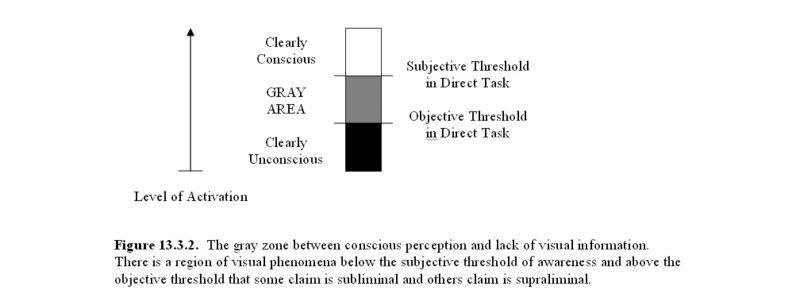
I was extremely satisfied to find this depiction of perception. no matter the specific topic in which it is presented. 'Objective versus Subjective Thresholds of Awareness' sounds very much what we are trying to do with determining the minimum threshold of sufficiency when making an examination.
Once I got over Dr. Busey's explanation was that for him to learn and understand fingerprint examiners, he would have to design experiments that the examiner would make errors. Including forced choices. Yuk, I thought, we would not like that. But he explained that is how he learns about us. The experiments would not be normal examinations. OK, so trusting the desire to learn, Let's do it, as we have been doing. Maybe, he will help us better understand what is our objective and subjective levels of sufficiency for fingerprint identification.
I really do enjoy collaborating beyond a small community.
“
[Palmer 641-642]Objective versus Subjective Thresholds of Awareness. Cheesman and Merikle (1984) argued that Marcel’s direct measure of conscious perception was inadequate because subjects may simply have been too conservative in reporting that they saw a word rather than a blank. They reasoned that the best way to find the actual threshold of conscious perception would be to have subjects make a forced-choice discrimination…., guessing if they were unsure…
Cheesman and Merikle (1984) called their forced-choice discrimination measure – ‘which of these four words did you see’ – the objective threshold of awareness. Following Eriksen (1960), they believed that consciousness should be defined relative to an objective measure showing that the subject has no visual information from the stimulus in a direct perceptual task. They contrasted their approach with Marcel’s yes/no detection measure – ‘Did you see anything or not?’ – which they called the subjective threshold of awareness….
Ideally, a direct measure of conscious perception should satisfy two criteria (Merikle & Reingold, 1992):
1. Exhaustiveness. The measure should exhaust the contents of consciousness. That is, it should wring out every last bit of information the observer has in his or her conscious experience of the stimulus event. Anything less opens the door to the objection that performance in the indirect task may reflect conscious information that has escaped measurement by the direct task. These are the grounds on which Marcel’s (1983a) original detection measure of the so-called subjective threshold of awareness can be criticized.
2. Exclusiveness. The measure should reflect exclusively the contents of consciousness. That is, it should measure only aspects of conscious experience. It is not appropriate if it also taps nonconscious processes that underlie true guessing behavior. These are the grounds on which Cheesman and Merikle’s (1984) discrimination measure of the so-called objective threshold of awareness can be criticized.
A scientist who is trying to define consciousness experimentally is thus on the horns of this dilemma. Both criteria are important, yet they seem nearly impossible to satisfy simultaneously.
We are left in a gray zone lying between two different thresholds, as depicted in Figure 13.3.2. The lower bound is Cheesman and Merikle’s objective threshold of awareness. Surely, no one is aware of anything below this level, for it is defined as the point at which visual input has no measurable effect on behavior in direct perceptual tasks. The upper bound is Marcel’s subjective threshold of awareness, the point at which people are willing to assert that they have had a visual experience. We will presume that every sighted person is aware of visual input above this level and will report it as conscious – unless they are lying. The gray area in between is bona fide subliminal perception to those who advocate identifying consciousness with subjective thresholds but bogus subliminal perception to those who advocate objective thresholds. It appears that an impasse has been reached. Is there any way around it?”
I was extremely satisfied to find this depiction of perception. no matter the specific topic in which it is presented. 'Objective versus Subjective Thresholds of Awareness' sounds very much what we are trying to do with determining the minimum threshold of sufficiency when making an examination.
Once I got over Dr. Busey's explanation was that for him to learn and understand fingerprint examiners, he would have to design experiments that the examiner would make errors. Including forced choices. Yuk, I thought, we would not like that. But he explained that is how he learns about us. The experiments would not be normal examinations. OK, so trusting the desire to learn, Let's do it, as we have been doing. Maybe, he will help us better understand what is our objective and subjective levels of sufficiency for fingerprint identification.
I really do enjoy collaborating beyond a small community.