Page 1 of 1
Interesting Patterns
Posted: Thu Sep 13, 2007 11:12 am
by Ann Horsman
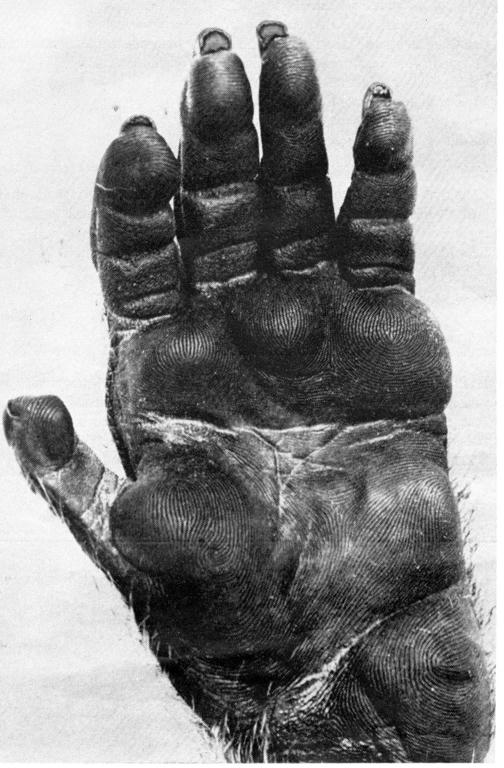
Ridge detail from a baboon.

Baboon ridge detail
Posted: Thu Sep 13, 2007 1:45 pm
by sharon cook
Yeah, I knew they'd get my ex-husband for something sooner or later.
Posted: Fri Sep 14, 2007 3:36 am
by David Fairhurst
This probably sounds like a silly question but...
Is that a hand or a foot?
Now a more intelligent question...
Do you know what species of baboon it is?
Posted: Fri Sep 14, 2007 3:41 pm
by Ann Horsman
David,
That is a right front paw, they are four legged creatures for a mode of travel. It is a dog (male) Chacma baboon. Baboons are monkeys and not apes, yes, there is a difference.
Sharon - Ouch!

Posted: Sun Sep 16, 2007 5:15 am
by mdavis
I can't see the "fingerprint" patterns, but the palm sure blows Ron Smith's pattern recognition tips into the weeds!

Posted: Mon Sep 17, 2007 8:11 am
by Heidi Fraser
Lol... so if you've had Ron's class and still can't orient the print, it must be a baboon?

I'll have to keep that in mind on my next CTS test...
Posted: Mon Sep 17, 2007 9:36 am
by Steve Everist
Here's one from an old article:
Here's a link to the hi-res PDF of the article (I only have one page):
http://www.mediafire.com/?1jzrjutmqna
Posted: Thu Sep 20, 2007 6:54 am
by Alan C
Looking at those two hands/paws, I see there are a lot of similarities in ridge flow. And of course the shape of the hand is similar, not to mention very different from mine or yours. Well, I guess I can only speak for myself.

Posted: Thu Sep 20, 2007 7:14 am
by David Johnson
Whipple and Wilder have some reasearch on different animals and their fingerprint patterns.
Interesting, but unless we get called out to a zoo prob. wont run into it to much.
Posted: Fri Sep 21, 2007 12:58 pm
by sharon cook
Most of the subjects we identify ARE baboons, I think. I wonder if the placement of the volar pads and the positions of the hands/paws during gestation is different than us? I think baboons have an extra volar pad low down on the palm, don't they?
Anyway, the next time you get one of those long, narrow palmprints with a lot of weird ridge flow...you know that one didn't get very far up the evolutionary ladder...........and speaking of O.J...
Oh, no you didn't!
Posted: Mon Sep 24, 2007 4:07 am
by gerritvolckeryck
In 1937, a gentleman named Mutrux-Bornoz, H., published a book called "Les troublantes révélations de l'empreinte digitale et palmaire" on his research concerning apes' (or baboons, whatever) finger- and palmprints.
In the 20's Locard reported about a case in which a trained little monkey-thief was identified through his fingerprints.
Got some pictures, if anyone's interested.
Gerrit
Posted: Mon Sep 24, 2007 8:05 am
by Ann Horsman
gerritvolckeryck wrote:
In the 20's Locard reported about a case in which a trained little monkey-thief was identified through his fingerprints.
Gerrit
Hmm, so primate fingerprints could be of value? That would make an interesting AFIS database.

Posted: Mon Sep 24, 2007 10:53 am
by Justice Pie
sharon cook wrote:Most of the subjects we identify ARE baboons, I think. I wonder if the placement of the volar pads and the positions of the hands/paws during gestation is different than us? I think baboons have an extra volar pad low down on the palm, don't they?
Is it redundant and safe to say that evolutionary wise, the form of locomotion might have a direct cause and effect on the development of extra volar pads? The baboons, commonly being quadrapeds would need that extra pad?
The top photo of the baboon's palm shows wear consistent with (a) mason(ry)...?
Posted: Tue Sep 25, 2007 5:16 pm
by mdavis
The mostly circular patterns would suggest friction necessary in all directions, something that we don't rely on with our palms. I haven't read the articles cited above (thanks, guys), but the utility of such whorls on the volar pads is very interesting.
Posted: Wed Sep 26, 2007 3:55 am
by Ann Horsman
I think the elongated pisiform in the baboon's hand creates the 'heel' and possibly an extra volar pad.